This is a rush transcript. Copy may not be in its final form.
AMY GOODMAN : “At the Purchaser’s Option” by our next guest, Rhiannon Giddens. This is Democracy Now! , democracynow.org, The War and Peace Report . I’m Amy Goodman.
As we continue our Juneteenth special, we turn now to the pioneering musical artist Rhiannon Giddens. She first gained fame as a member of the Grammy Award-winning Carolina Chocolate Drops, a Black string band which inspired a new generation of Black musicians to play the banjo and fiddle. Giddens has gone on to have a celebrated solo career and has even collaborated with Beyoncé. Giddens’s banjo playing can be heard on “Texas Hold ’Em,” a hit single by Beyoncé, who became the first Black woman to ever top the Billboard ’s Hot Country Songs chart.
In 2023, Rhiannon Giddens won a Pulitzer Prize for her opera Omar , about Omar ibn Said, a Muslim scholar in Africa sold into slavery and forcefully brought to Charleston, South Carolina, in 1807. In a moment, we’ll hear Rhiannon Giddens talk about Omar . But first, an excerpt from the song “Julie’s Aria” from the opera Omar .
RHIANNON GIDDENS : [singing] My daddy wore a cap like yours
He got down on his knees and he faced the rising sun
And he did it again when the day was done
He wouldn’t need this and he wouldn’t need that
No matter the lee, no matter the fed
He drove my mama crazy, but she loved him anyway
They found each other in the darkness
The way they looked at the world wasn’t the same
But the way that they looked at each other, there was the flame
They sold my daddy down when I was ten
I’ve never grown as fast as I did then
AMY GOODMAN : That’s “Julie’s Aria” from Rhiannon Giddens’s Pulitzer Prize-winning opera Omar , which she wrote with Michael Abels. I spoke to her in October 2023 on the day she received the Pulitzer Prize.
AMY GOODMAN : Rhiannon, this is just astounding. Can you talk about the life of Omar ibn Said?
RHIANNON GIDDENS : I can, yeah. He was a 37-year-old Qur’anic scholar, who had been studying, you know, for all of his adult life, and even when he was a child. And he was 37 years old, and he was sold into slavery. His compound was overrun, and he was sold, and he had to go over the Middle Passage, and he ended up in Charleston, was his first port of call. And he was sold to a man there, that he, I think, used him pretty badly, like put him in the fields and treated him very badly. And, you know, he ran away from him, and he ended up in North Carolina. And they found him in a jail. They put him in jail, because you couldn’t just be a random Black person walking around. Somebody had to own you, or you were, you know, imprisoned. And so he was put into jail. And he was found there, and he had written on the walls, with the ashes, verses of the Qur’an. And so, he was sold to a family in North Carolina, where he lived out the rest of his life, another 50 years. He lived into his eighties and was never freed.
And the reason we know who he is is that he wrote an autobiography in Arabic. So, he was pressed upon to write the story of his life, even though he begins it with “I cannot write my life,” because this was 20 years after he had been brought to the United States. And it’s just a remarkable document. It’s the only — as best as the scholars who’ve told me know, it’s the only autobiography written by an enslaved person while they’re enslaved, that we have, you know, anywhere in the United States. And it’s definitely the only document written in Arabic by an enslaved person. So, it’s a really special thing that we have it.
And I was commissioned by the Spoleto Festivals, the first opera they commissioned, to write an opera, and I brought in Michael Abels, who’s an incredible composer and film scorer, and who knows the orchestra and knows how to write for orchestra. I know how to write for banjo and for voice. So, between the two of us, we created the score for Omar , and I wrote the libretto. And it was a really intense experience, you know.
But it’s just so amazing that Omar’s story has been — is being lifted by this opera, being lifted by the existence of this work, and more and more people are knowing about him, because the whole point for me was to complicate the — again, the complication — to complicate the American narrative, like who gets to say that they represent the American story, you know? Why is — why is the Mayflower 's — you know, somebody who came on the Mayflower , why is that held up as representational, when Omar's is just as representational? It’s just not as — you know, it’s not as pleasant. It’s very challenging, and also that there were so many Muslims that were brought over to the United States, and they have, you know, a massive impact on the culture and, in some places, the language. You know, if you go to the Georgia Sea Islands, where you can trace some of the words in Guale to Arabic.
So, it’s just — it’s just an opportunity to really just kind of blow things wide open and go…
Read the full article at Democracy Now! →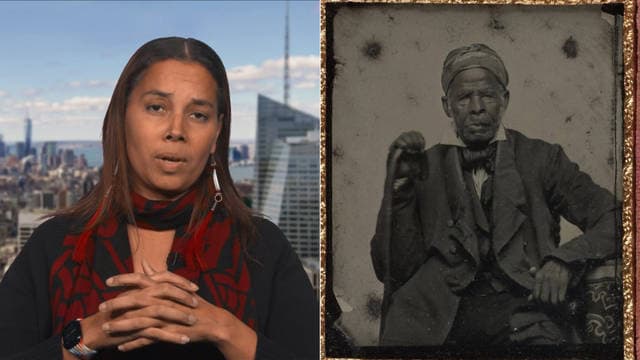
 United States