A recent proposal by the Republika Srpska, a constituent entity of Bosnia and Herzegovina, to criminalize the public display and promotion of the wartime symbols of the Army of the Republic of Bosnia and Herzegovina (ARBiH)—particularly its iconic lily emblem—has ignited widespread controversy and national backlash. The proposal, outlined in amendments to the Republika Srpska Criminal Code, could result in prison sentences of up to three years for individuals who publicly display or promote these symbols. This move has been sharply criticized by Bosniak officials, political parties, and legal experts, who argue that it undermines constitutional principles, historical truth, and international recognition of Bosnia and Herzegovina.
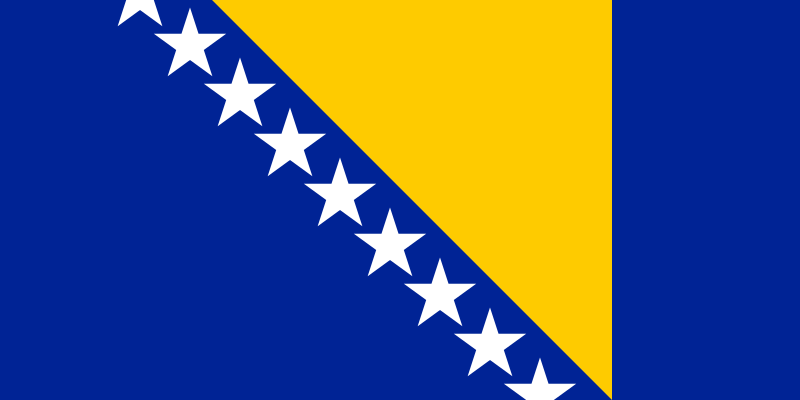
At the heart of the dispute lies the symbolic significance of the lily flag, which became synonymous with the internationally recognized Republic of Bosnia and Herzegovina during the 1992–1995 war. According to legal scholars and former constitutional advisers, this flag represents the constitutional continuity of the state, having been used when Bosnia and Herzegovina joined the United Nations in May 1992. The lily is not merely an ethnic or religious symbol but rather a representation of the nation’s sovereignty and legitimacy. Critics argue that the Republika Srpska’s attempt to criminalize these symbols is an effort to erase or distort historical reality, particularly given that the state’s military heritage—including the ARBiH—is already legally protected under state laws.
The irony of the situation is further underscored by the fact that Republika Srpska’s own courts have previously rejected attempts to penalize the display of the lily flag, concluding that it belongs to an internationally recognized state. Now, instead of challenging past judicial decisions, the entity appears to be changing the law to align with its current political agenda. Legal analysts suggest that such a shift reflects a broader pattern of authoritarian tendencies in the region, where historical narratives are manipulated to serve contemporary political interests.
Political leaders from Bosniak communities and pro-state parties have strongly condemned the proposal, emphasizing that it contradicts the constitution and existing state legislation. For instance, the Party of Democratic Action (SDA) has stated that the ARBiH was “the legal armed force of an internationally recognized state,” and that criminalizing its symbols is an affront to both national identity and international law. Similarly, the Party for Bosnia and Herzegovina (SBiH) has accused the ruling Alliance of Independent Social Democrats (SNSD) of exploiting the issue to stoke ethnic divisions.
Legal experts, including former constitutional law adviser Slaven Kovacevic, have warned that the proposal risks undermining the very foundations of Bosnia and Herzegovina’s statehood. They argue that while governments can regulate symbols, they cannot retroactively alter historical facts. The lily flag, they note, remains a powerful reminder of the country’s emergence as a sovereign state, and its suppression would represent a profound betrayal of democratic values and historical memory.
This debate takes place against a backdrop of ongoing political stagnation in Bosnia and Herzegovina, where reforms aimed at meeting European Union accession criteria have stalled for years. The country continues to lack key legislative frameworks, including laws governing the State Council (VSTV) and the Constitutional Court, as well as a designated chief negotiator for EU talks. These unresolved issues have contributed to a sense of frustration among citizens and international observers alike, who see little progress toward modernization and integration.
As the political landscape remains frozen, the upcoming visit of High Representative of the European Union for Foreign Affairs and Security, Kaja Kallas, is seen by many as another missed opportunity for meaningful change. While her visit may bring attention to the stalled reforms, critics argue that without genuine political will and cooperation, the status quo will persist. Former Prime Minister Milorad Dodik has even suggested that continued interference by external actors like Kallas only serves to undermine Bosnia and Herzegovina’s autonomy and sovereignty.
In conclusion, the Republika Srpska’s proposal to criminalize the lily flag is not just a legal matter—it is a deeply symbolic act that touches upon questions of national identity, historical truth, and the rule of law. As the country grapples with its complex legacy and uncertain future, the battle over these symbols reflects a larger struggle for control over the narrative of Bosnia and Herzegovina’s past and present. Whether this conflict leads to greater unity or deeper division remains to be seen.
3 reports
 Dnevni avazParty-alignedLeftyesterday
The article discusses the controversial legal measures in the Republic of Serbian Krajina (Republika Srpska) that could criminalize the display of the flag of Bosnia and Herzegovina. It highlights how autocratic regimes on the Balkans often manipulate historical narratives rather than engage with them objectively. The focus is on a proposed law that would equate the symbols of the Independent State of Croatia (NDH) with the flag of Bosnia and Herzegovina, which is internationally recognized and a member of the United Nations. The author argues that this attempt to equate two historically and legally distinct entities reflects a broader effort to rewrite history through legislation. The article notes that while courts previously rejected such claims by distinguishing between the international recognition of Bosnia and Herzegovina’s flag and symbols of hatred, the new law seeks to change this interpretation. This move is seen as an attempt to erase inconvenient truths about the region’s past, despite the fact that history cannot be altered by decree.
Bias read (Left): The article frames the issue as a struggle against authoritarian manipulation of history, emphasizing the importance of international recognition and legal legitimacy. It criticizes attempts to redefine historical facts through legislation, aligning with progressive values that prioritize truth and,
 N1 Bosna i HercegovinaIndependentCenteryesterday
The government of Republika Srpska, the Serb-majority entity in Bosnia and Herzegovina, has proposed amending its Criminal Code to impose prison terms of up to three years for publicly displaying or promoting the symbols of the Army of the Republic of Bosnia and Herzegovina (ARBiH). These symbols, particularly the fleur-de-lis (lily) design, were prominently used during the 1992–1995 war and are seen as representing the legacy of Bosnia and Herzegovina as an internationally recognized state. Bosniak officials and several political parties, including the Party of Democratic Action (SDA) and People and Justice (NiP), have strongly opposed the proposal, calling it unconstitutional and an attempt to rewrite history. They argue that the ARBiH's military heritage is already protected under state law and that the lily flag symbolizes constitutional continuity. The proposal has sparked nationwide backlash and could lead to legal challenges at the Constitutional Court.
Bias read (Center): The article presents multiple perspectives from both the Republika Srpska government and opposing Bosniak political groups, providing quotes and arguments from all sides without overtly favoring any particular viewpoint. The framing remains balanced, focusing on legal and historical arguments rather
N1 Bosna i HercegovinaIndependentCenter4 days ago On the eve of the arrival of Kaya Kallas, BiH would still be without key legislation and a chief negotiator.The article discusses the upcoming visit of Kaja Kallas, the High Representative of the European Union for Foreign Affairs and Security, to Bosnia and Herzegovina (BiH). The visit comes three months before elections and amid ongoing political stalemate. Key issues such as the lack of crucial laws related to the Constitutional Court (VSTV), the BiH Court, and the appointment of a chief negotiator remain unresolved. Despite the high-level visit, many believe little will change until a new government is formed. Officials and experts note that BiH continues to lag in reforms, leading to financial losses and increased debt. The article highlights concerns over stalled progress and the potential impact of external pressures, including tensions between Italy and the EU.
Bias read (Center): The article presents a balanced view of the situation, citing both official concerns and expert opinions without overtly favoring any particular political stance. It reports on the challenges faced by BiH in meeting EU conditions for negotiations while acknowledging the broader political context and
★
Keep the news honest.
ObjectiveNews is reader-funded and ad-free — we show you the bias instead of hiding it. Support independent journalism for €5/month.
Become a Supporter
 BA
BA



